


Brazilian companies are increasingly adopting IoT (internet of things) devices as an essential resource in the process of digitally transforming their activities. The main objectives are to increase management efficiency and productivity, with the aim of boosting results, especially in highly competitive sectors such as agribusiness, industry, health and logistics.
By monitoring assets and identifying failures, patterns and trends, the performance of these ecosystems of connected devices is decisive in the administrator's decision-making process on market strategies, business models and the destination of investments.
According to a survey by the International Data Corporation (IDC), Brazilian companies invested around R$ 8.5 billion in IoT last year - 17.6% above the volume recorded in 2021.
The same consultancy estimates that this amount could reach R$ 11.2 billion by 2026, driven by the expansion of the 5G network in the country. During this period, for example, private high-speed mobile networks are expected to grow by more than R%.
Another study by the Mobile Ecosystem Forum (MEF) of 450 Brazilian business leaders found that 50% of the country's large corporations already have at least one active IoT application. In addition, 52% have committed to developing a second application with this technology for activation in the short term. Finally, 80% of the companies said they intend to invest in expanding their existing IoT architectures.
More profitability
Much of the Brazilian market's interest in the Internet of Things is due to the publication of the National IoT Plan (Decree No. 9.854) in 2019. The measure was fundamental in establishing a favorable environment for the development of technology in the country. The main objectives of this document are:
I - improve people's quality of life and promote efficiency gains in services by implementing IoT solutions;
II - promote professional training related to the development of IoT applications and the creation of jobs in the digital economy;
III - increase the productivity and foster the competitiveness of Brazilian IoT developers by promoting an innovation ecosystem in this sector;
IV - seek partnerships with the public and private sectors to implement the IoT; and
V - to increase the country's integration into the international scene, through participation in standardization forums, international cooperation in research, development and innovation and the internationalization of IoT solutions developed in the country.
That same year, a partnership was signed between the Brazilian Ministry of Economy, the São Paulo State Government and the World Economic Forum's Center for the Forth Industrial Revolution - C4IR Brazil, to help remove barriers to access to the “internet of things” for Brazilian small and medium-sized enterprises (SMEs).
The initiative produced a protocol of specific actions aimed at public policymakers to support businesses in this transition process. These include technological and financial support, raising awareness of IoT and promoting business partnerships between companies.
The strategy was initially applied to 10 companies in the aeronautics and automotive sectors, and was later expanded to another 70 Brazilian companies. According to the World Bank, the results have been largely positive:
21.6% recorded an increase in operational efficiency;
+192% return on investment, on average;
80% to confirm the continuity of the strategy.
In other words: at the end of the day, investing in smart and connected device infrastructure results not only in operational gains, but also in a robust return on investment (ROI).
The adoption of sensors and devices that simplify, speed up and automate the work and production dynamics of medium-sized and small companies has been essential for their competitive alignment with large corporations, guaranteeing profitability.
According to the World Economic Forum, the modernization of SMEs is essential for global GDP growth, since they represent 90% of the world's companies, responsible for creating economic opportunities and social mobility, creating seven out of every ten jobs in the world.
Around the world
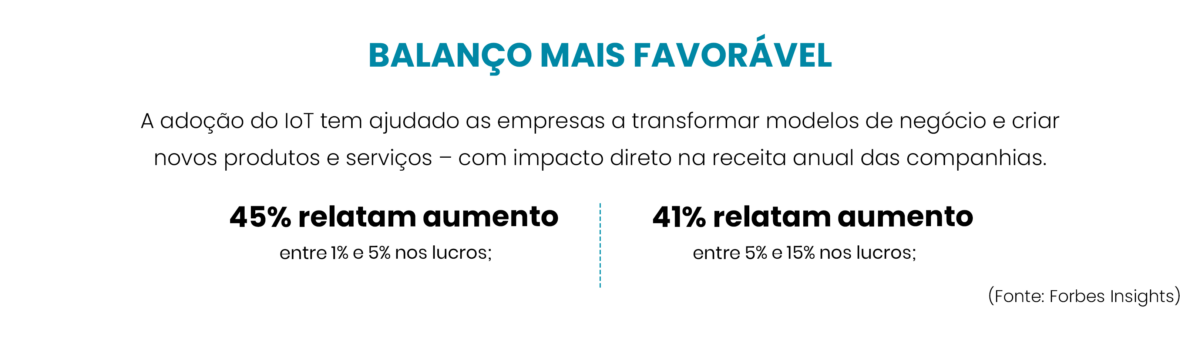
Business transformation through the use of the IoT is also being seen on a global scale. A recent Forbes Insights survey of 700 executives from around the world showed that 60% of companies have expanded their business by developing new product and service lines and 36% are considering creating them in the short and medium term.
As in the domestic market, the expansion of 5G coverage in other countries is one of the reasons for this IoT boom. Broadband has made it possible to traffic data obtained by devices in greater volume and much faster, unlocking a series of applications hitherto considered distant from reality.
The British research and analysis institute Juniper predicts that IoT connections with 5G will exceed 116 million interactions by 2026 - exponential growth of 1,100% in three years, driven by applications in the healthcare and smart cities segments, which require very low latency sensing.
It's also important to note that one of the reasons for the IoT's business surge is the blatant reduction in the average price of sensors over the last two decades, falling from US$ 1.30 (2004) to US$ 0.38 (2020). The increase in the number of suppliers, which increases supply, and technological optimization have lowered the cost of production, making the technology more accessible.
Corporate sustainability
Ecosystems of connected devices integrated into businesses have helped to reduce the impact of corporations on the environment. An analysis by the World Economic Forum suggests that 84% of the 640 IoT applications evaluated meet or have the potential to meet the targets for decarbonizing the economy set out in the Sustainable Development Goals (SDGs) drawn up by the United Nations (UN).
Among the most common uses for this purpose are:
Managing water leaks
The IoT enables real-time protection against damage caused by leaks or failures in water supply systems. Optical sensors and an integrated approach can prevent billions of dollars in waste and a repeat of the water crisis of recent years;
Predictive
MaintenanceDevices connected to industrial machines provide data that feeds into models for preventing potentially damaging events, such as accidents, breakdowns and the need to replace parts and components, avoiding unforeseen downtime of equipment. Study of Deloitte suggests that, on average, predictive maintenance increases productivity by 25%, reduces the risk of plant downtime by 70% and cuts normal maintenance costs by ¼.
Environmental monitoring
Installed in pipes, air circulation systems and spaces used by employees, these devices can identify pollutants in the air or water, preventing contamination and making workplaces not only cleaner, but also safer.