Data Center Technology Maturity Journey: from Reactivity to Zero-Outage

The data center maturity journey shows how to evolve from reactive operations to high-availability (Zero-Outage) environments, with integrated governance, processes and technology

November 11, 2025

Does your data center anticipate failures or only react when they have already happened? This is the central question of data center maturity journey - the path that guarantees more availability, cost predictability and strategic resilience.

According to the report Uptime Institute's Annual Outage Analysis 2024, Power outages continue to be the main cause of serious downtime in data centers, followed by IT and air conditioning problems. The study also shows that a significant proportion of outages generated financial losses of more than US$ 100,000, with several cases exceeding millions of dollars.

Another critical point is the human factor: process errors and operational failures are among the most recurrent causes of downtime. And even with advances in the industry, major disruptions continue to happen every year, This shows that no critical operation is immune.

This data shows that technological maturity is not just about modern equipment or redundancy in design. It depends on the ability to foresee risks, answer precisely e evolve continuously.

Technological maturity in data centers, therefore, is directly linked to the ability to structuring solid processes, establishing efficient governance e integrating physical infrastructure e IT - transforming availability into strategic resilience.

What technological maturity means in a data center

Technological maturity in data centers is the degree to which the operation is able to align its critical assets - energy, climate control, security and IT - with data-based management, structured processes and efficient governance.

In practice, maturity means answering fundamental questions:

Can your data center anticipate failures or does it just react when they happen?

Are the reports manual and time-consuming, or generated automatically in real time?

Is there clear governance between facilities and IT, or do the teams still work in silos?

Are energy performance and expandability continuously monitored?

According to the Uptime Institute (Annual Outage Analysis 2024), even with advances in technology, critical failures continue to occur every year in global data centers. Energy is identified as the main cause of serious downtime, but human error and process failures are also among the recurring factors. This shows that technological maturity goes beyond physical infrastructure: it requires operational discipline, continuous monitoring and integration between areas.

The more advanced the answers to these questions, the more mature your data center will be. And the greater your ability to turn availability into strategic resilience, protecting both service continuity and your company's reputation and bottom line.

-

+Incidents | +Calls

MATURITY

+Availability | +Reliability

+

Journey life ~ 18 months

Physical layer

Weather

Electrical

Infrastructure

Security

Automation

The 4 stages of the Technological Maturity Journey

The data center maturity journey shows how the operation evolves from reactivity to Zero-Outage. Each stage includes key questions, key performance indicators (KPIs) and typical risks.

1.

Operational Base - Fundamentals of Operational Visibility

At this stage, the focus is on building the foundation: technical reports, one-off automation and the first performance indicators. The operation is still reactive, but is beginning to see beyond the immediate.

Typical questions:

Are your reports still manual and time-consuming?

Do you only react when the problem occurs or do you already have some level of anticipation?

Do the facilities and IT teams work in isolation?

KPIs for this stage:

MTBF (Mean Time Between Failures):
High, but unreliable due to lack of traceability.

% of reactive incidents vs. planned:
A reactive majority.

MTTR (Mean Time to Repair):
High, without standardization.

Automation fee:
Low or non-existent.

2.

Intelligent Foundation - Structuring the Technical Base

The infrastructure is beginning to reveal previously invisible patterns. Log analysis and indicators make it possible to locate faults quickly. Asset management becomes more organized, but still requires human effort to interpret data.

Questions that indicate progress:

Does the infrastructure already show clear patterns of failure and performance?

Can your team spot faults quickly?

Does governance between facilities and IT already exist or does it still depend on improvisation?

KPIs for this stage:

Mean time to detection (MTTD):
It starts to fall with basic monitoring.

Recurring incident rate:
Still relevant, but tracked.

Data center availability:
~98%.

Asset inventory accuracy:
Partial, in spreadsheets or isolated systems.

3.

Strategic Architecture - Intelligent and Proactive Operation

Advanced monitoring tools, predictive and preventive maintenance, and support from artificial intelligence make it possible to correlate events. Energy efficiency becomes measurable and predictable, and MTTR begins to fall dramatically.

Questions that differentiate this stage:

Do you already use predictive and preventive maintenance supported by sensors and AI?

Are your reports generated automatically in real time?

Is energy performance continuously monitored (PUE)?

Is future capacity planned on the basis of historical data and simulations?

KPIs for this stage:

Availability:
above 99.9%.

PUE (Power Usage Effectiveness):
monitored and continuously improved.

MTTR:
< 4h in critical assets.

% planned vs. corrective maintenance:
predominantly predictive and preventive.

Number of false alarms:
reduced with intelligent correlation.

4.

Zero-Outage: final stage of the data center maturity journey - Strategic Architecture and Integral Reliability

At the highest level, the data center acts as an integrated body. The DCIM centralizes facilities and IT information; retrofits and upgrades keep the operation up to date; and governance guides strategic decisions based on reliable data.

Questions that confirm full maturity:

Do you have documented and regularly tested continuity plans?

Are your investment decisions based on reliable KPIs?

Do Facilities and IT work together on a single management platform?

Is technological evolution continuous, with planned retrofits and upgrades?

KPIs for this stage:

Availability:
≥ 99.995%.

Energy efficiency:
PUE close to 1.2-1.3.

MTTR:
close to zero in critical incidents.

ESG KPIs
automatic reports on consumption, emissions and efficiency.

Annual critical incident rate:
minimum.

Capacity planning time:
done with “what-if” simulations.

Data Center Technology Maturity Day

The data center maturity journey shows how the operation evolves from reactivity to Zero-Outage. Each stage includes key questions, key performance indicators (KPIs) and typical risks.

Stage

1. Operational Basis (Fundamentals of Operational Visibility)

2. Intelligent Foundation (Structuring the Technical Base)

3. Strategic Architecture (Intelligent and Proactive Operation)

4. Zero-Outage (Strategic Architecture and Integral Reliability)

Typical KPIs

- MTBF: high/unreliable
- MTTR: high
- % reactive incidents: majority
- Automation rate: low

- MTTR: starting to fall
- Availability: ~97-98%
- Recurring incident rate: still high
- Asset inventory: partial

- Availability: ≥99.9%
- MTTR: <4h on critical assets
- PUE: monitored
- % planned maintenance: predominantly predictive/preventive
- False alarms: Reduced

- Availability: ≥99.995%
- MTTR: close to zero
- Critical incidents: minimal
- PUE: 1.2-1.3
- ESG KPIs: automatic reports
- Capacity: simulated with "what-if"

Key capabilities

Basic inventory, occasional monitoring, manual reports

Initial dashboards, integrated logs, organized asset management, start of governance

Advanced monitoring, AI for event correlation, partial DCIM, intelligent alarms

Complete DCIM, end-to-end automation, ESG reporting, robust governance

Typical risks

High risk of unplanned downtime; lack of traceability

Flaws known, but reaction time still high

Dependence on isolated tools, without full integration

Risk of technological obsolescence if there are no retrofits

Financial indicators/ROI

High OPEX with corrective maintenance; unforeseen costs

Costs begin to stabilize; better control of OPEX

Positive ROI with energy savings; reduction of emergencies

Optimized OPEX; investments guided by simulations; ESG metrics on the board

Practical examples

Maintenance only when it breaks down; Excel spreadsheets as the main tool

Isolated dashboards for energy and IT; partial governance

24x7 NOC correlating events; expansion planning based on data

Sustainability reports presented to the board; operation seen as a competitive advantage

Typical KPIs

- MTBF: high/unreliable
- MTTR: high
- % reactive incidents: majority
- Automation rate: low

Key capabilities

Basic inventory, occasional monitoring, manual reports

Typical risks

High risk of unplanned downtime; lack of traceability

Financial indicators/ROI

High OPEX with corrective maintenance; unforeseen costs

Practical examples

Maintenance only when it breaks down; Excel spreadsheets as the main tool

Typical KPIs

- MTTR: starting to fall
- Availability: ~97-98%
- Recurring incident rate: still high
- Asset inventory: partial

Key capabilities

Initial dashboards, integrated logs, organized asset management, start of governance

Typical risks

Flaws known, but reaction time still high

Financial indicators/ROI

Costs begin to stabilize; better control of OPEX

Practical examples

Isolated dashboards for energy and IT; partial governance

Typical KPIs

- Availability: ≥99.9%
- MTTR: <4h on critical assets
- PUE: monitored
- % planned maintenance: predominantly predictive/preventive
- False alarms: Reduced

Key capabilities

Advanced monitoring, AI for event correlation, partial DCIM, intelligent alarms

Typical risks

Dependence on isolated tools, without full integration

Financial indicators/ROI

Positive ROI with energy savings; reduction of emergencies

Practical examples

24x7 NOC correlating events; expansion planning based on data

Typical KPIs

- Availability: ≥99.995%
- MTTR: close to zero
- Critical incidents: minimal
- PUE: 1.2-1.3
- ESG KPIs: automatic reports
- Capacity: simulated with "what-if"

Key capabilities

Complete DCIM, end-to-end automation, ESG reporting, robust governance

Typical risks

Risk of technological obsolescence if there are no retrofits

Financial indicators/ROI

Optimized OPEX; investments guided by simulations; ESG metrics on the board

Practical examples

Sustainability reports presented to the board; operation seen as a competitive advantage

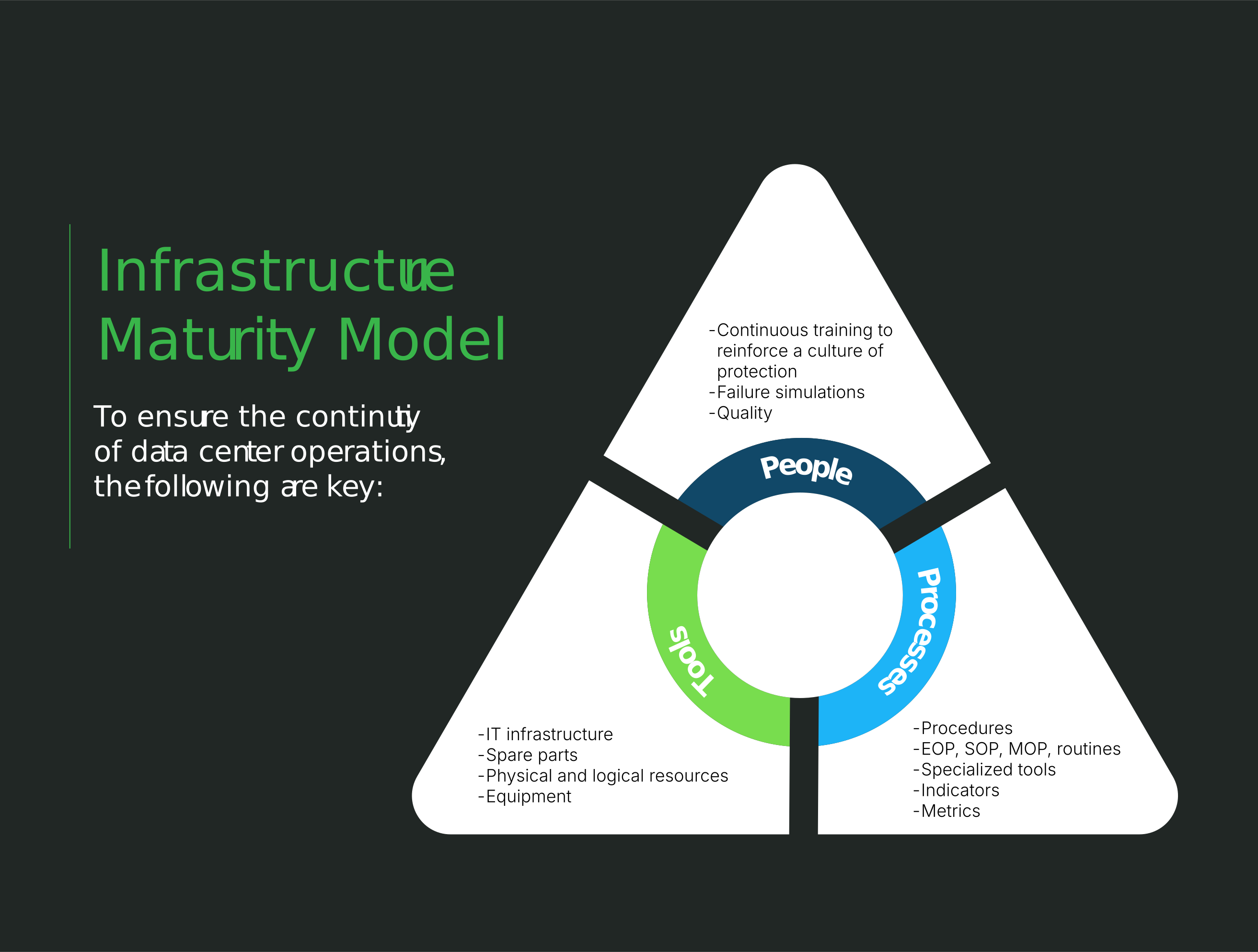
The three pillars of technological maturity in data centers

The journey to maturity in data centers doesn't just depend on modern equipment or redundancy declared in the project. The real difference lies in the balance between three fundamental pillars: people, processes and tools.

1. People

Trained professionals are the front line of resilience. Without continuous training, a culture of prevention and failure simulations, even the most advanced infrastructure is vulnerable.

Insight Uptime (2024): Human error and process errors are still among the main causes of downtime in data centers.

2. Processes

Maturity requires clear governance, reliable indicators and standardized methodologies (EOP, SOP, MOP). Structured processes reduce risks, increase predictability and transform the data center maintenance into a strategic routine.

Insight Uptime (2024): the report shows that many outages could have been avoided with consistent operational practices and regular testing.

3. Tools

Tools support the journey: from certified critical infrastructure to real-time monitoring systems and traceable spare parts. They make it possible to anticipate failures, optimize consumption and ensure continuity.

These three vertices form the triangle of technological maturity in data centers - a model that shows how availability depends on the integration between human capabilities, consistent methodologies e appropriate tools.

Pilar

What it represents

Impact on maturity

Risk without evolution

People

Training, prevention culture, failure simulations

Reduces human error and increases response efficiency

Operating errors, undiagnosed faults

Processes

Governance, reliable KPIs, methodologies (EOP/SOP/MOP)

Provides predictability and standardizes reactions to incidents

Irregular maintenance, lack of traceability

Tools

Certified infrastructure, real-time monitoring, traceable parts

Fault anticipation, energy efficiency, continuity

Unexpected faults, excessive consumption, unavailability

What it represents

Training, prevention culture, failure simulations

Impact on maturity

Reduces human error and increases response efficiency

Risk without evolution

Operating errors, undiagnosed faults

What it represents

Governance, reliable KPIs, methodologies (EOP/SOP/MOP)

Impact on maturity

Provides predictability and standardizes reactions to incidents

Risk without evolution

Irregular maintenance, lack of traceability

What it represents

Certified infrastructure, real-time monitoring, traceable parts

Impact on maturity

Fault anticipation, energy efficiency, continuity

Risk without evolution

Unexpected faults, excessive consumption, unavailability

The role of AI and DCIM in evolution

  • Artificial Intelligence: enhances predictive maintenance, by detecting patterns invisible to the human eye and predicting failures days or weeks before they occur.

This combination speeds up the transition between stages and drastically reduces the risk of downtime.

Benefits for managing critical environments

For managers, technological maturity is not just an operational gain: it translates directly into service continuity and reliable availability, These are the basis for any strategic decision.

  • Availability: drastic reduction in critical failures and increase in the actual SLA, ensuring that digital systems never stop.

  • Cost predictability: less emergency spending, more budget planning and better control over the life cycle of assets.

  • Energy efficiency and ESG: automatic reports on consumption and emissions, in line with environmental and corporate governance targets.

  • Compliance and auditing: complete traceability of interventions, supporting regulatory requirements and external audits.

  • Strategic decision: Reliable data turns infrastructure into a business lever, allowing investments to be guided by solid indicators.

How to move forward on the journey

In green4T, We understand that technological maturity is not achieved overnight - it requires vision, method and constant monitoring. That's why we act as strategic partner, by driving your data center's evolution through our model of technological maturity, validated in hundreds of critical environments in Latin America.

Our integrated approach:

  • Ongoing: more than maintenance, it is continuous monitoring 24×7×365, with a focus on predictive and preventive maintenance that guarantees availability and reduces risks.

  • DCIM: a platform that delivers total visibility in real time, eliminating silos between facilities and IT and enabling decisions.

  • National presence: technicians distributed in more than 61 cities, ensuring rapid response and close support in any critical operation.

Combining engineering, technology and processes, the green4T guides companies at every stage, from Zero-Outage Operating Base, transforming infrastructure into strategic resilience.

FAQ - Data Center Technology Maturity Journey

What does the data center technology maturity journey mean?

It is the process that measures how your operation evolves from a reactive model to a Zero-Outage model, in which failures are predicted before they occur and infrastructure is no longer just a cost but a strategic business asset.

Because critical operations cannot stop. An immature data center increases the risk of unavailability, chain failures and emergency expenses. Mature environments, on the other hand, deliver:

  • Proven availability (above 99.9%).

  • Cost predictability, with fewer emergencies.

  • Energy efficiency and automatic ESG reports.

  • Reliability to support digital growth.

  • Operational base: focus on manual reports and reactive operation.

  • Intelligent Foundation: patterns begin to be identified, initial governance.

  • Strategic Architecture: predictive and preventive maintenance, advanced monitoring and AI support.

  • Zero-Outage: full integration via DCIM, with integral reliability and robust governance.

Ask yourself:

  • Do you anticipate failures or just react to them?

  • Are reports automated in real time or still manual?

  • Do Facilities and IT work together or in silos?

  • Is the actual availability SLA above 99.9%?

These answers, combined with KPIs such as MTTR, PUE and annual critical incidents, help diagnose your stage.

DCIM is the backbone of maturity. It integrates energy, climate control, security and IT data into a single view, enabling:

  • Data-driven decision making;

  • Reducing organizational silos;

  • Automatic reports for compliance and ESG.

A AI applied to predictive maintenance analyzes signals invisible to the human eye - vibration, thermal micro-variations, energy consumption - and correlates them in real time. This makes it possible to predict failures days or weeks in advance, reduce false alarms and trigger interventions only when there is a real risk.

It depends on the initial stage. Companies with basic automation can evolve in months; others, with fragmented infrastructure, take an average of 18 months. The pace depends on investments and the adoption of governance processes.

  • Recurring unavailability which compromises critical services.

  • Unpredictable costs with emergency maintenance.

  • Energy inefficiency which increases OPEX and the carbon footprint.

  • Loss of competitiveness, because immature environments don't support digital scalability.

In addition to greater availability and reliability, the return comes from:

  • Reduction of unplanned downtime (minus financial losses).

  • OPEX optimization with energy and maintenance.

  • Better allocation of CAPEX, avoiding unnecessary investments.

  • Gaining reputation by presenting consistent ESG reports to the board and investors.

green4T acts as strategic partner in the technological maturity journey, He has validated his model in hundreds of critical environments in Latin America.

  • OngoingMore than maintenance, it is the continuous 24×7 monitoring of critical infrastructure, anticipating failures with predictive and preventive measures to transform availability into strategic resilience.

  • DCIMplatform that delivers total visibility in real time, eliminating silos between facilities and IT and enabling decisions based on reliable data.

  • National coverageThe company's technical team is distributed in more than 61 cities, ensuring a rapid response and close support for any critical operation. This combination accelerates your evolution, bringing security, financial predictability and strategic alignment, with the confidence of those who already support leading organizations in sectors such as finance, telecommunications, industry and government.

No critical operation is born mature. It evolves or it fails. Technological maturity is what separates vulnerable data centers from resilient operations. With integrated processes, governance and technology, your critical infrastructure ceases to be just a cost center and becomes a strategic business asset.

Want to find out what stage your operation is at? Request a maturity diagnosis with green4T and plot your next step in the technological journey.


Privacy Overview

This website uses cookies so that we can provide you with the best user experience possible. Cookie information is stored in your browser and performs functions such as recognising you when you return to our website and helping our team to understand which sections of the website you find most interesting and useful.

Strictly Necessary Cookies

Strictly Necessary Cookie should be enabled at all times so that we can save your preferences for cookie settings.

Analytics

This website uses Google Analytics to collect anonymous information such as the number of visitors to the site, and the most popular pages.

Keeping this cookie enabled helps us to improve our website.

Marketing

This website uses the following additional cookies:

(List the cookies that you are using on the website here.)