
In February, the heaviest rainfall ever recorded in 24 hours in the history of Brazil left 65 people dead in the region of São Sebastião, on the north coast of São Paulo. This climatic catastrophe immediately sparked a series of discussions about how to protect the most vulnerable populations in cities from episodes like that and prevent similar tragedies from happening again in the country.
This is a concern that is not restricted to Brazilian society. All over the world, the same sentiment is growing due to the effects of global warming on the planet's climate. Heat waves, violent storms, hurricanes, tornadoes, devastating floods and long periods of drought, which drastically reduce food production and result in hunger, form a frightening picture, especially in countries and places with fewer resources.
To tackle it, it is essential that these nations manage to improve the standard of living of lower-income inhabitants, improve urban infrastructure and develop more efficient response systems for extreme events.
In short, you need to create resilience for cities in the face of climate disasters. This concept was defined at the World Conference on Disaster Reduction in Kobe, Japan, in 2005: it sums up the degree of capacity that individuals, communities and public and private organizations need to organize themselves and learn from past episodes in order to reduce the risk of their repetition in the future - whether at local, regional, national or global level - and respond to the challenge that the planet has imposed.
Japan vs. Haiti
However, building resilience requires investment and this has divided the planet into two blocs: the countries with the financial power to change the course of their history and those that remain adrift, highly vulnerable to new catastrophes.
Japan and Haiti are two examples of this divide. In March 2011, the Asian country suffered the most powerful earthquake in its history, with a magnitude of 9.0, which resulted in a tsunami with waves of 40 meters, destroying cities on the Pacific coast such as Iwate, Miyagi and Fukushima.
Due to its geographical position on one of the edges of the Pacific Ring of Fire, where several tectonic plates meet, the Japanese archipelago is frequently hit by natural disasters. A hard, daily lesson in the need to make the country more resilient to these catastrophes.
Particularly since the last major earthquake, the Japanese authorities have become even more committed to developing mitigation solutions. Robust public investments in new technologies and partnerships with giants in the electronics industry have put the country at the forefront when it comes to “disaster techs”.
The city of Sendai, for example, has made a squadron of robot drones available to act before and after a possible tsunami. In the initial phase, they fly over the coastal area, warning the population to evacuate urgently. After the waves hit, the drones - equipped with infrared cameras - actively search for survivors in the affected areas, transmitting images and locations in real time directly to the city's crisis management center.
In Okazaki, 39 sensors have been installed in urban areas with a history of flooding. The system detects with high precision any accumulations of water on rainy days, alerting the Civil Defense and Traffic authorities to take the necessary protective measures.
In the Itabashi district, in the capital Tokyo, residents have exclusive access to a website that provides information on the weather and the level of the river that runs through the area, allowing people to be aware of the risk of disaster online and in real time.
Finally, Kanagawa Prefecture is testing an application based on artificial intelligence that guides people on what actions to take in the event of an evacuation, based on the analysis of data and information provided by the weather service and Civil Defense.
In the opposite direction, Haiti has sunk into a serious humanitarian crisis since a devastating earthquake destroyed the capital, Port-au-Prince, in January 2010, claiming 230,000 lives and leaving a million people homeless.
A year after the quake, measuring 7.3 on the Richter Scale, only 5% of the houses had been rebuilt. One hundred thousand Haitians were still living in temporary shelters. With the destruction of the basic sanitation and public health infrastructure, the city went through a cholera epidemic that killed another 4,000 people. Misery and chaos set in for good.
READ MORE: D-tech: technology to combat natural disasters
Humanitarian and economic costs
The impact of extreme weather events is therefore even greater in underdeveloped countries. One of the immediate effects is an increase in the population pushed into poverty.
One World Bank study indicates that these natural disasters cost around US$ 520 billion in lost consumption capacity and push 26 million people into poverty every year. In addition to Haiti, other examples corroborate this thesis.
In 2005, the crisis caused by Hurricane Stan in Guatemala's economy caused 7.3% of the affected families to send their children to work instead of school. In 2010, Cyclone Aila raised Bangladesh's unemployment and poverty levels by 49% and 22% respectively. Three years later, an estimated one million Filipinos were pushed to the bottom of the social pyramid after Typhoon Haiyan scraped the public coffers for emergency works.
According to AON insurance report, The economic losses caused by natural disasters - many of them caused by climate change - reached US$ 313 billion in 2022.
There were at least 421 events in the year, such as floods and hurricanes, compared to an average of 396 since the beginning of the century. The company said most of the policies were paid out because of the destruction caused by Hurricane Ian, which hit Florida in September. The assessed structural damage amounted to around US$ 55 billion. The total economic loss amounted to US$ 95 billion.
The intangible cost in lives was also high. Approximately 31,300 people lost their lives in 2022 because of these catastrophes - two thirds of the deaths related to the severe heatwaves in Europe between June and July.
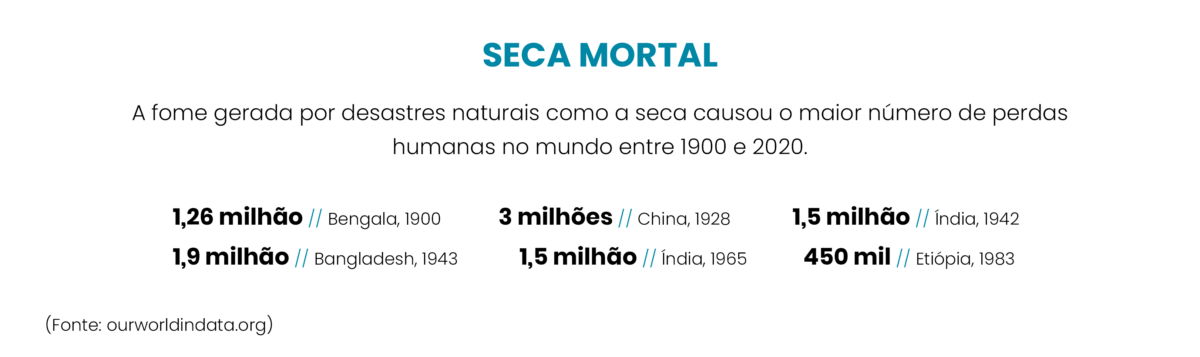
However, survey by the organization Our World in Data reveals that the number of fatalities caused by this factor, including earthquakes and volcanic activity, has been falling in recent decades. The document points out that between the beginning and the middle of the 20th century, the total number of fatalities often exceeded 1 million, with an average of 400/500,000 per year. From the 1970s onwards, this average fell to less than 100,000.
The main reason for this decrease, according to the researchers, would be precisely an increase in the capacity of nations to anticipate, respond to and mitigate the impact of these events. Not coincidentally, it was also in the second half of the last century that the development of new technologies, computing and data processing picked up speed.
Data and lives
The use of technology in the management of natural disasters and climatic events is the most assertive method for reducing the risks of humanitarian tragedies, financial losses and providing greater resilience to cities.
Among the main technological tools that have helped public authorities in risk and disaster management are:
- Ecosystems of connected devices (IoT) collect data on the most vulnerable areas, meteorological changes, volcanic activity, among others, to immediately activate containment measures and subsequently generate valuable insights for formulating preventive strategies;
- ‘Digital twins’ (digital twins) allow for virtual simulations of mitigation solutions and impact studies in areas affected by natural events;
- Big data generated from remote sensing platforms helps to identify gaps and indicate the allocation of resources;
- Artificial intelligence in assessing the economic impact caused by prolonged events such as droughts or rainy periods;
- Intelligent and integrated communication systems, with automated tools that guarantee the efficient transmission of data and information, are essential for natural disaster prevention and mitigation strategies;
- Drones with high-resolution cameras help with damage assessment, increase situational awareness and help rescue and medical support teams plan their actions more effectively;
- Robots guided by GPS and thermal cameras to support rescue teams in areas that are difficult to access and/or where there is a risk to their lives;
- Blockchain to guarantee the automated and incorruptible functioning of data collection and updating processes for impact models, as well as helping to provide transparency for contracts and anti-disaster programs;
- Open source software can help rescue teams identify and allocate medical resources and supplies, manage volunteers and track down the missing;
- Social networks allow the status and location of survivors to be marked, aiding search teams.
The role of IT
At the back of this entire management network, which produces voluminous loads of data, images and information, you need a robust, secure and highly available IT infrastructure.
Data centers that are able to withstand the demand in crisis situations and are sufficiently protected by redundant systems and watertight, flameproof and impact-resistant structures, so that they themselves are not impacted by the instabilities of the weather or the ground.
In 2021, the green4T has taken over the IT operation of the Command and Control (C2) unit of the Espírito Santo government's new Civil Defense Intelligence Center (Cidec). The site integrates and centralizes all data related to the state's climate, helping local authorities make decisions in crisis situations.
IT also has another important role to play: helping to reduce the environmental impact of the technology sector through more energy-efficient data centers.
In order to prevent, manage and mitigate the effects of natural disasters on cities and vulnerable populations, data intelligence is essential. And it must be obtained in the most sustainable way possible.