


The challenge, in most cases, is not the lack of data. It is the lack of context. Power consumption, assets, alarms, capacity and inventory are spread across disconnected systems and spreadsheets.
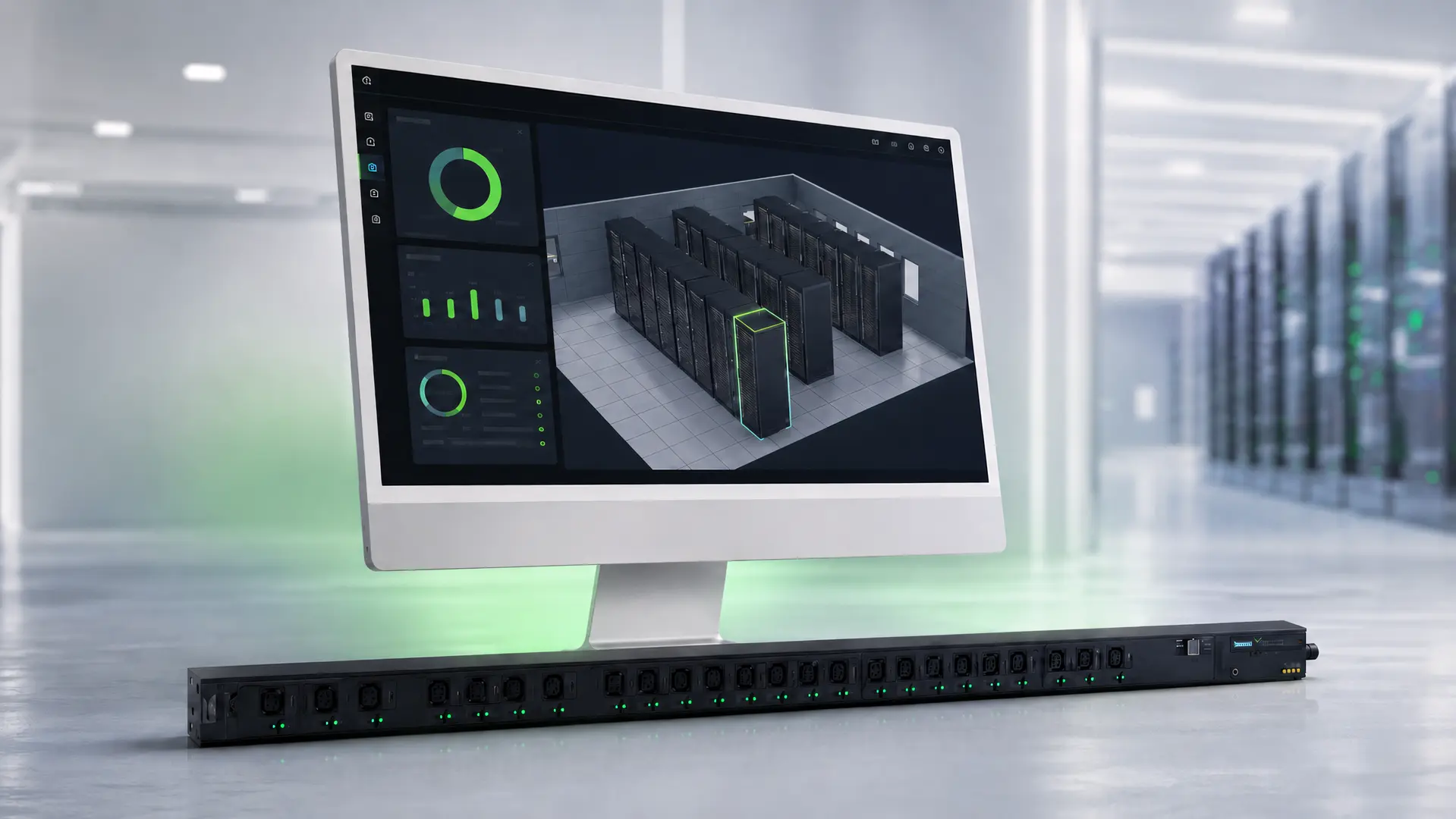
This is where the integration of DCIM and Intelligent Rack PDUs becomes especially relevant.

An Intelligent Rack PDU measures electrical behavior at the point closest to the load: the rack.
DCIM connects this data to assets, capacity, environmental conditions, historical data and planning.
Together, they answer the questions that disconnected systems and spreadsheets cannot:

An Intelligent Rack PDU measures electrical behavior at the rack level. DCIM provides operational context.
Pillar
Operational Challenge
What Changes
Aggregate monitoring does not reveal load behavior within individual racks.
Operations gain visibility into power consumption, load, phases, circuits and capacity limits at the exact point where the load resides.
Installed capacity is often mistaken for available capacity.
Teams measure actual headroom by rack, phase and circuit before planning new workloads or expansion.
Electrical anomalies often go unnoticed until an incident occurs.
Granular visibility reveals load imbalance, saturation and diminishing headroom before overload occurs.
Spreadsheets, manual validation and fragmented data consume valuable technical time.
Data becomes integrated, traceable and ready to support decision-making, as well as energy consumption reporting and analysis.
The value lies not in monitoring energy, but in turning electrical data into the foundation for better decisions about risk, capacity, operational priorities, efficiency and growth.
Another benefit is becoming increasingly important: energy reporting. Structured metering makes consumption traceable by customer, cage, room, area, or cost center—providing the foundation for fair cost allocation, efficiency targets, and growing energy and emissions reporting requirements.
Standalone Power Monitoring
Standalone Power Monitoring:
Standalone Power Monitoring:
Standalone Power Monitoring:
Standalone Power Monitoring:
Standalone Power Monitoring:
Standalone Power Monitoring:
Standalone Power Monitoring:
Standalone Power Monitoring:
Standalone Power Monitoring:
Standalone Power Monitoring:
Standalone Power Monitoring:
Standalone Power Monitoring:
Standalone Power Monitoring:
Standalone Power Monitoring:
Compatibility between Intelligent Rack PDUs and the DCIM platform;
Reporting by customer, area, rack, cage, or cost center;
Required metering granularity: rack, phase, circuit, or outlet level;
Scalability to support future expansion;
Metering accuracy and integration with existing systems;
Access security and ease of management;
Continuous monitoring, configurable alerts, and historical consumption data;
Technical support and proven experience in mission-critical operations.
The value lies not in the PDU or DCIM alone, but in integrating granular measurements with operational context.
Power consumption is monitored only in aggregate;
Available capacity depends on spreadsheets or estimates;
The team manually verifies information at the rack;
Power data is not connected to assets;
There is no clear visibility into loads by phase, circuit, or rack;
Expansion planning lacks predictability;
Energy cost allocation relies on estimates;
Localized risks are identified too late;
Operational reporting consumes too much of the team’s time.
Estimate payback, annual return on investment, and the economic potential of integrating DCIM with Intelligent Rack PDUs based on your data center’s characteristics.
They provide clear visibility into power consumption, capacity, risk, and efficiency. An Intelligent Rack PDU measures electrical data at the rack level, while DCIM organizes that data within the context of data center operations. green4T assesses the existing infrastructure, identifies visibility gaps, and connects electrical data to data center management.
An Intelligent Rack PDU measures electrical data at the rack level. DCIM connects this data to assets, capacity, environmental conditions, historical data, and planning. green4T structures this integration so data center operations can move beyond isolated measurements and use contextualized data.
Because standalone metering provides numbers; integrated with DCIM, it reveals impact, available headroom, risk, and priority. green4T connects power consumption, load, capacity, and asset data to the operational context needed to make informed decisions about expansion, load redistribution, and efficiency.
Power monitoring tracks consumption, current, and load. Capacity management shows where headroom remains and where adding new loads could create risk. green4T supports this transition—from standalone power readings to clear visibility into available headroom, localized risks, and actual use of installed capacity.
They identify where capacity headroom remains, which racks are approaching their limits, and where loads can be redistributed before expansion becomes necessary. green4T assesses load distribution, operational history, and the areas that require adjustment or additional capacity.
An Intelligent Rack PDU measures power consumption, load, phases, and circuits at the rack level, while DCIM organizes this data to show where additional load can be added. green4T connects electrical measurements to the data center infrastructure context to guide equipment installation, load redistribution, or capacity expansion.
An Intelligent Rack PDU collects data directly at the rack level, while DCIM centralizes the information, reducing on-site inspections and isolated checks. green4T assesses spreadsheet-dependent processes and recommends ways to improve traceability and consistency.
They identify racks, phases, or circuits approaching their limits, enabling teams to act before an overload develops. green4T defines the metering and integration architecture so operations can work with granular data rather than averages.
Depending on the architecture and metering granularity, consumption can be attributed to a rack, customer, cage, room, area, or cost center with full traceability. green4T determines the appropriate metering level and integrates the data with DCIM to provide clear visibility into consumption, margins, and capacity utilization.
Yes. In high-density data centers, even small load variations can affect power headroom, cooling, and capacity distribution. Rack-level monitoring identifies points approaching their limits, while green4T guides decisions on load redistribution, expansion, or infrastructure adjustments.
of existing infrastructure, operational needs, and visibility gaps.
of the appropriate metering and data management architecture.
of Intelligent Rack PDUs, DCIM, and existing systems;
of power, asset, capacity, environmental, and historical data.
of consumption, capacity headroom, operational risks, and trends.
of data center efficiency, visibility, and operational maturity.
Schedule an assessment of your operation’s blind spots with a green4T expert.
We use cookies and similar technologies to ensure the website functions properly, improve your browsing experience, and analyze how our content is used. These technologies help us understand how visitors interact with the website, allowing us to continuously improve our services and features. By clicking “Accept,” you consent to the use of these technologies as described in our policies.